
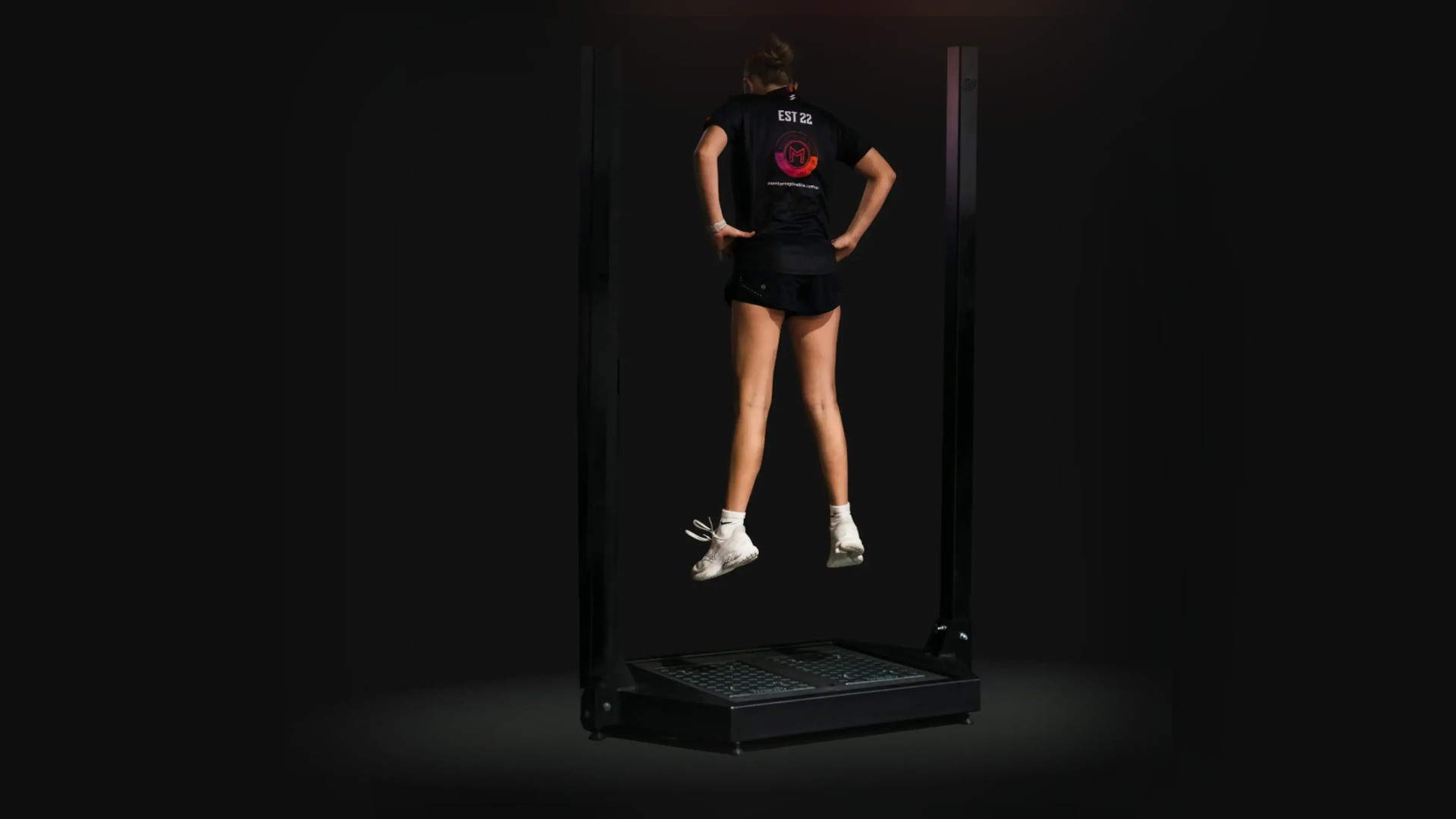
Jump height is the least interesting number on the report. What force plates measure, how to read your own results, and why the same height can mean two different things.
The countermovement jump is the most-used test in performance sport, and the most misread. An athlete stands on a pair of plates, dips, jumps, lands. The number everyone screenshots is how high they got. That is the one number on the report that tells you the least.
What the plates are actually recording
A force plate does not measure height. It measures the force going through the floor, sampled hundreds of times a second, for the entire movement. Height is then calculated backwards from that. Everything genuinely useful lives in the shape of the curve on the way there.
- How fast force is produced, not just how much. Two athletes can reach an identical peak with one taking twice as long to get there.
- How deep and how quickly the athlete loads before reversing direction.
- How efficiently the lowering phase feeds the jump that follows it.
- Left versus right contribution, through both take-off and landing.
- How the athlete absorbs the landing, which is where a lot of injury risk becomes visible before it becomes painful.
Same height, different athlete
Two fifteen-year-olds jump 38 centimetres. The first gets there with a fast, shallow dip and a sharp reversal, riding elastic qualities they already have. The second sinks slowly, sits at the bottom, and grinds it out on raw force. Identical on a stat sheet, opposite training needs.
The first athlete needs strength underneath their speed, or they will plateau the moment their elasticity stops improving. The second needs to learn to express what they have quickly. Programme them the same way and one of them wastes a season. This is the entire argument for testing rather than guessing.
Reading your own report
Three habits make the numbers useful. Compare against yourself, because the athlete you were three months ago is the only fair benchmark and the internet averages you are about to search for are drawn from populations that are not you. Test under the same conditions, since a jump taken after a session and one taken before it are different tests with different answers. And watch asymmetry as a trend rather than panicking at a single reading, because a gap that appears once is usually noise and a gap that appears and stays is a conversation.
Why we retest
A single test is a photograph. It tells you where an athlete is and almost nothing about whether anything is working. The value arrives on the second test, and compounds on the fourth. A block of training either moved the numbers it was designed to move or it did not, and that is a far more useful conversation than an argument about whether the program felt hard. It is also why the monthly coaching review on both centre pathways is built around the athlete's own data rather than around how the last few weeks felt.
Retesting also catches the things nobody reports. Athletes do not usually volunteer that one leg has felt off for a fortnight. A widening asymmetry says it for them, early enough to do something cheap about it.
What it is not
It is not a selection tool and it does not predict who makes it. Plenty of athletes with unremarkable force plate numbers play at a high level, and plenty of athletes who test beautifully never do. What the test does, reliably, is tell you whether the last block of training changed anything, and give you an early warning when something is heading in the wrong direction.
That is a smaller claim than most testing is sold on, and it is the one worth paying for. Athletes on our Development and Performance pathways are baselined on VALD force plates when they join, and their programming is built off those numbers from there. The point is never the first number. It is the second one.